
Medicare IRMAA Explained: Why Higher-Income Beneficiaries Pay More — and What You Can Do About It
The Medicare Surcharge That Catches High-Income Retirees by Surprise
You planned carefully for retirement. You built savings, maybe sold a business or a property, converted part of a retirement account to a Roth. Then a letter arrives from Social Security informing you that your Medicare premium is significantly higher than your neighbor's — even though you're in the exact same plan.
Welcome to IRMAA: the Income-Related Monthly Adjustment Amount. It's one of the least understood pieces of Medicare, and one of the most consequential for anyone with a higher income in retirement. Here's exactly how it works, why it exists, and what — if anything — you can do about it.
What Is IRMAA?
IRMAA is a surcharge added on top of your standard Medicare Part B and Part D premiums if your income exceeds certain thresholds. It applies whether you have Original Medicare or a Medicare Advantage plan, since Part B premiums (and Part D IRMAA, if you have drug coverage) still apply either way.
Importantly, IRMAA is based on your Modified Adjusted Gross Income (MAGI) — your Adjusted Gross Income plus any tax-exempt interest, such as municipal bond income — from your tax return filed two years prior to the current premium year. Your 2026 Medicare premiums, for example, are based on your 2024 tax return.
2026 Income Thresholds and Surcharges — The Current, Official Figures
These are the official 2026 numbers published by CMS — the figures currently in effect. For 2026, the standard Part B premium is $202.90 per month. IRMAA begins to apply once your income exceeded $109,000 as a single filer or $218,000 filing jointly. From there, surcharges increase across a five-tier sliding scale.
One important mechanic to understand: Medicare premiums always run on a two-year income lookback. Your 2026 premium is determined by the income on your 2024 tax return — not because the data is old, but because that's simply how the rule is written. Your 2027 premium, once CMS finalizes it, will be based on your 2025 return, and so on. Every beneficiary's current premium is always tied to income from two years back — that's not unique to this article, it's baked into the program.
What IRRMA You'll Pay in 2026 — Part B & Part D
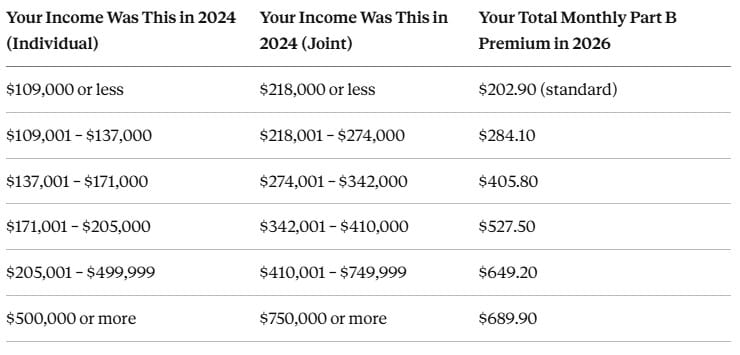
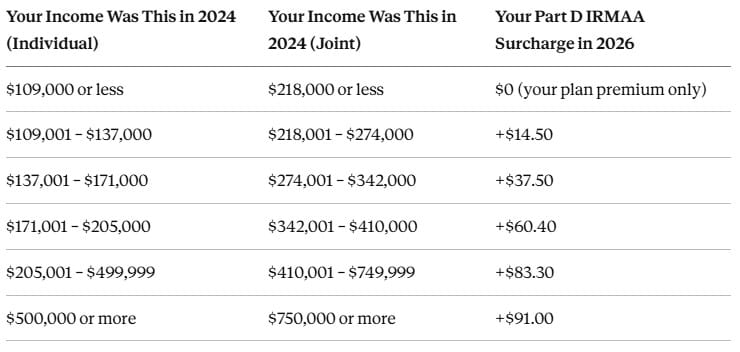
NOTE: Part D IRRMA is on top of your Part D premium.
A separate, compressed bracket structure applies to beneficiaries who are married but file separately (and lived with their spouse during the tax year) — those thresholds start at the same $109,000 mark but jump to much higher surcharge tiers far more quickly, so this filing status deserves its own careful review.
Looking ahead to 2027: CMS typically announces the following year's IRMAA brackets and standard Part B premium in October or November. The 2027 figures — based on 2025 income — had not yet been officially released as of this writing. This page will be updated with the confirmed 2027 numbers as soon as CMS publishes them.
Why Do Beneficiaries Have to Pay This IRRMA Surcharge?
IRMAA exists because Medicare Part B and Part D are only partially funded by beneficiary premiums — the rest comes from general federal revenue. IRMAA was created so that beneficiaries with higher incomes cover a larger share of that cost, shifting some of the overall program funding burden toward those most able to absorb it, rather than spreading it evenly across every enrollee regardless of income.
It's also worth understanding the "cliff" nature of these brackets: crossing a threshold by even one dollar moves you into the next full tier — there's no gradual phase-in. That's exactly why year-end income timing (a large capital gain, an IRA withdrawal, a Roth conversion) can have an outsized effect on Medicare costs two years later.
How Long Do You Have to Pay IRRMA?
Here's the encouraging part: IRMAA is not a permanent penalty. Unlike the late enrollment penalties for Part B or Part D, IRMAA is reassessed every year based on your MAGI from two years prior. If your income drops — for example, after a one-time capital gain year passes, or after retirement income settles into a lower steady state — your IRMAA surcharge can decrease or disappear entirely in a future year, without any special action beyond your normal tax filing.
Can You Appeal or Reduce IRRMA?
Yes, in two distinct ways:
1. Requesting a new determination based on outdated or incorrect data. If the IRS sent Social Security an old tax return, or your tax return was later amended, you can contact the Social Security Administration directly and request a corrected look at more current information.
2. Filing for a life-changing event. If your income has dropped because of a specific qualifying event, you can file the Medicare Income-Related Monthly Adjustment Amount – Life-Changing Event form (SSA-44) with Social Security. Recognized events generally include:
Marriage, divorce, or annulment
Death of a spouse
Reduction or loss of work
Loss of income-producing property (through no fault of your own)
Loss or reduction of certain pension income
This form allows Social Security to use a more current, and often lower, income estimate rather than the two-year-old tax return that would otherwise apply.
Legitimate Ways to Manage Future MAGI
Because IRMAA is based on income from two years earlier, the real opportunity is proactive planning, well before you're close to a threshold. A few strategies retirees and their financial and tax professionals commonly consider:
Timing large income events. Spreading out a Roth conversion, property sale, or large IRA withdrawal across multiple years, rather than realizing it all at once, can help avoid pushing a single year's MAGI into a higher bracket.
Qualified Charitable Distributions (QCDs). For those old enough to take required IRA distributions, directing part of that distribution straight to a qualified charity can reduce MAGI compared to taking the full distribution as taxable income.
Watching tax-exempt interest. Since municipal bond interest is added back into MAGI for IRMAA purposes, it isn't automatically "invisible" to this calculation the way it is for some other tax purposes.
Reviewing bracket room before year-end. Because the tiers are a cliff system, checking exactly how much room remains before the next IRMAA threshold — before finalizing a big financial move in December — can prevent an avoidable jump.
None of these strategies are guarantees, and what makes sense depends heavily on your full financial and tax picture — this is exactly the kind of planning best done alongside a tax professional or financial advisor, with your Medicare costs as one input among several.
Not Sure Where You Stand? Let's Look at the Full Picture
IRMAA can feel like an unwelcome surprise, but with the right information ahead of time, it's manageable — and sometimes avoidable. As a licensed, independent Florida agent, Dean Vella can walk through how IRMAA may affect your specific Medicare costs and help you understand your options, at no cost to you.
This guide is for educational purposes and does not constitute medical, legal, or tax advice. Proper Coverage Insurance is not connected with or endorsed by the U.S. government or the federal Medicare program. We are an independent, licensed insurance agency offering Medicare plan comparisons in Florida.
Content reviewed as of July 2026. Medicare rules, deadlines, and penalty calculations are set by CMS and Social Security and are subject to change — always confirm current requirements before making an enrollment decision.