
Medicare Part A and Part B Explained: What's Covered, What It Costs, and Where the Gaps Are
Original Medicare Isn't One Thing — It's Two
When people say "I have Medicare," they're almost always describing two separate programs working together: Part A and Part B.
Together, they're known as Original Medicare. Understanding exactly what each one covers — and just as importantly, what neither one covers — is the foundation for every other Medicare decision you'll make, including whether you need a Medicare Advantage plan or a Medicare Supplement.
Here's the full picture, using the most current cost figures available.
Medicare Part A: Hospital Insurance
Part A covers inpatient hospital care, skilled nursing facility (SNF) care, hospice care, inpatient rehabilitation, and certain home health services.
Part A Premium
Roughly 99% of beneficiaries pay $0 per month for Part A, since they or a spouse paid Medicare payroll taxes for at least 40 quarters (10 years) of qualifying work. For those with fewer work quarters:
30–39 quarters of coverage: $311/month in 2026
Fewer than 30 quarters: $565/month in 2026
Part A Deductible and Coinsurance — 2026 Figures
Part A doesn't use a single annual deductible the way Part B does. Instead, it works around a benefit period — which begins the day you're admitted as an inpatient and ends once you've been out of inpatient hospital or skilled nursing care for 60 consecutive days.
If you're readmitted after that 60-day break, a brand-new benefit period (and a new deductible) begins.
Part A Costs
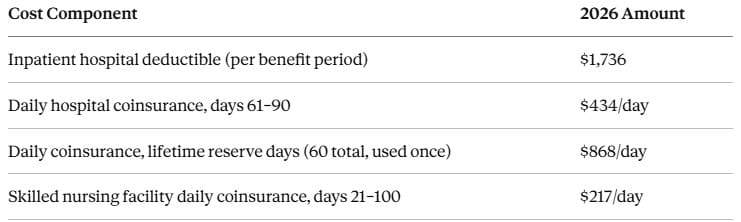
A few details that matter in practice:
Days 1–60 of a hospital stay: You pay the deductible once per benefit period; Medicare covers the rest.
Days 61–90: Daily coinsurance applies on top of what you've already paid.
Beyond day 90: You draw from a lifetime bank of 60 reserve days — once used, they don't renew.
Skilled nursing facility care: The first 20 days in a benefit period are covered in full after a qualifying hospital stay; days 21–100 carry the daily coinsurance above; after day 100, you're responsible for the full cost.
Hospice care: Most covered services carry no deductible, though small copayments may apply for outpatient prescription drugs and respite care.
Home health services: Typically covered in full when criteria are met, with no deductible or coinsurance for the covered home health visit itself.
What Part A Does Not Cover
Long-term custodial care (help with daily living activities alone, without skilled medical need)
A private hospital room, unless medically necessary
Private-duty nursing
Extended hospital stays beyond 90 days once lifetime reserve days are exhausted
Skilled nursing facility care beyond 100 days in a benefit period
Medicare Part B: Medical Insurance
Part B covers outpatient care, physician services, preventive care, durable medical equipment (DME), ambulance services, outpatient mental health care, and many diagnostic tests and screenings.
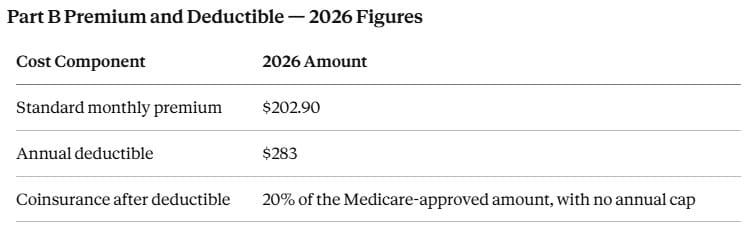
Higher-income beneficiaries pay more than the standard premium under IRMAA, based on income from two years prior — a topic covered in detail in our IRMAA guide.
How Part B Cost-Sharing Works in Practice
Once you meet the $283 annual deductible, Medicare generally pays 80% of the Medicare-approved amount for covered services, leaving you responsible for the remaining 20% coinsurance — with no out-of-pocket maximum.
This is the detail that catches so many beneficiaries off guard: under Part B alone, there is no ceiling on how much that 20% could add up to over the course of a serious illness or an extended treatment plan.
There's also the possibility of Part B excess charges — if a provider doesn't accept Medicare "assignment," they're permitted to charge up to 15% more than the Medicare-approved amount, and you'd be responsible for that difference on top of your normal coinsurance.
What Part B Does Not Cover
Routine dental care, dentures, and most dental procedures
Routine vision exams, eyeglasses, or contact lenses (outside specific post-surgical exceptions)
Hearing exams and hearing aids
Most prescription drugs you administer yourself (that's the role of Part D)
Long-term custodial care
Cosmetic surgery, except in specific medically necessary circumstances
Most care received outside the United States
Where This Leaves You: The Real Financial Exposure of Original Medicare Alone
Put Part A and Part B together, and here's the honest picture: Original Medicare covers a great deal, but it was never built to cap your total costs.
Between the Part A benefit-period deductible (which can apply more than once a year), the Part B annual deductible, and uncapped 20% coinsurance on outpatient and medical services, a serious health event — a major surgery, an extended hospitalization, an ongoing treatment plan — could result in thousands of dollars of exposure with no ceiling in sight.
This is exactly why the vast majority of Medicare beneficiaries pair Original Medicare with either a Medicare Advantage plan or a Medicare Supplement policy, rather than relying on Parts A and B alone.
How Medicare Advantage Bridges the Gap
A Medicare Advantage plan replaces the cost-sharing structure of Original Medicare with its own — typically featuring copays for specific services (like a set daily copay for hospital admission) instead of open-ended coinsurance, and critically, a required annual out-of-pocket maximum.
Once you hit that cap, the plan covers 100% of covered costs for the rest of the year. Most Advantage plans also bundle Part D drug coverage and often add benefits Original Medicare doesn't include at all, like dental, vision, and hearing.
How a Medicare Supplement Bridges the Gap
A Medicare Supplement (Medigap) policy takes a different approach: rather than replacing Original Medicare's structure, it pays some or all of the specific gaps left behind — the Part A deductible, Part B coinsurance, and in some plans, the Part B deductible and excess charges.
The trade-off is a higher monthly premium in exchange for highly predictable costs and the freedom to see any provider nationwide who accepts Medicare, with no network restrictions.
Neither path is universally better — the right choice depends on how you use healthcare, your budget, and whether predictability or bundled extra benefits matter more to you.
What matters most is recognizing that Parts A and B alone leave real financial exposure on the table, and closing that gap deliberately, rather than by accident, is one of the most important Medicare decisions you'll make.
Let's Review Your Full Picture — Parts A, B, and the Gap Between Them
Understanding your deductibles and coinsurance is only half the equation — knowing how to responsibly close the gap is the other half.
As a licensed, independent Florida agent, Dean Vella will walk through your specific health needs and budget, and help you decide whether a Medicare Advantage plan or a Medicare Supplement is the better fit for your situation — at no cost to you.
This article is for educational purposes only and does not constitute medical, legal, or tax advice. It is not connected with or endorsed by the U.S. government or the federal Medicare program. Costs, deductibles, and coverage rules are set annually by CMS and are subject to change. Speak with a licensed agent to review current, plan-specific details for your situation.
Content reviewed as of July 2026, reflecting confirmed 2026 CMS premium, deductible, and coinsurance figures. CMS typically announces the following year's Part A and Part B amounts in November — 2027 figures will be added to this page once officially released.