
Medicare Part D Explained: Prescription Drug Coverage, Costs, and How to Avoid a Permanent Penalty
The Part of Medicare Most People Don't Think About Until It's Too Late
Ask most people what Medicare covers, and they'll mention doctor visits and hospital stays. Prescription drugs rarely come up — until a trip to the pharmacy delivers a bill that doesn't match expectations.
Medicare Part D is the piece of the puzzle that covers your prescription medications, and how you handle it — from your very first enrollment window to which pharmacy you use — can make a real difference in what you pay for the rest of your life.
Here's what every Florida Medicare beneficiary should understand about Part D before making a decision.
How Part D Fits Into Your Overall Coverage
Part D isn't automatic, and it isn't one-size-fits-all. How you get it depends on which path you've chosen for your overall Medicare coverage:
If you're in a Medicare Advantage plan, prescription drug coverage is usually already built in — these are commonly called "MA-PD" plans. Most Advantage enrollees never need to shop for a separate drug plan because it's bundled with their medical coverage.
If you've chosen Original Medicare paired with a Medicare Supplement (Medigap) policy, drug coverage is not included. Medigap plans are designed to fill the cost-sharing gaps in Parts A and B — they don't touch prescription costs at all. That means anyone going the Supplement route needs to separately shop for and enroll in a standalone Part D plan.
This distinction trips up more people than almost any other part of the enrollment process. Choosing a Supplement without realizing you still need a separate drug plan can leave you without prescription coverage entirely — and exposed to the penalty described below.
The Penalty for Not Enrolling When You're Eligible
Just like Part B, Part D carries a late enrollment penalty for anyone who goes without "creditable" drug coverage (coverage that's at least as good as standard Medicare drug coverage) for 63 or more consecutive days after their Initial Enrollment Period ends.
Here's how it's calculated: Medicare adds 1% of the "national base beneficiary premium" for every full month you went without creditable coverage, and that amount is added to your Part D premium — permanently, for as long as you're enrolled in Part D. Unlike some costs that reset or cap out, this penalty generally never goes away.
Example: If someone goes 20 months without creditable drug coverage before enrolling, they'd carry a permanent penalty equal to roughly 20% of the national base beneficiary premium, added to whatever plan premium they eventually choose — every single month, indefinitely.
The takeaway: even if you don't take many medications today, enrolling in some form of creditable drug coverage when you first become eligible protects you from a penalty that compounds the longer you wait.
Avoid the Part D penalty. Schedule Your Free Part D Review With a Licensed Agent.
How Part D Enrollment Timing Differs From Part B
It's a common assumption that Part D and Part B run on identical enrollment rules. They actually diverge in a few important ways:
Initial Enrollment Period (IEP): Both share the same 7-month window around your 65th birthday, so this part lines up.
Creditable coverage matters more for Part D. With Part B, employer coverage from a qualifying large employer lets you delay penalty-free. With Part D, the standard is slightly different — your employer or union drug coverage must be certified as "creditable," meaning it's expected to pay, on average, at least as much as standard Medicare drug coverage. Employers are required to notify you each year whether your coverage qualifies.
Annual Enrollment Period (AEP): Part D has its own yearly window, October 15 – December 7, when you can join, switch, or drop a standalone drug plan for the following year. Part B does not have an equivalent annual "shopping window" — once you're enrolled, you're enrolled.
No mid-year reset like Part B. Part B is a single ongoing enrollment. Part D, by contrast, requires you to actively reassess your plan every year during AEP, since formularies, pharmacy networks, and costs can change annually even if you don't switch plans.
How Part D Enrollment Timing Differs From Part B
It's a common assumption that Part D and Part B run on identical enrollment rules. They actually diverge in a few important ways:
Initial Enrollment Period (IEP): Both share the same 7-month window around your 65th birthday, so this part lines up.
Creditable coverage matters more for Part D. With Part B, employer coverage from a qualifying large employer lets you delay penalty-free. With Part D, the standard is slightly different — your employer or union drug coverage must be certified as "creditable," meaning it's expected to pay, on average, at least as much as standard Medicare drug coverage. Employers are required to notify you each year whether your coverage qualifies.
Annual Enrollment Period (AEP): Part D has its own yearly window, October 15 – December 7, when you can join, switch, or drop a standalone drug plan for the following year. Part B does not have an equivalent annual "shopping window" — once you're enrolled, you're enrolled.
No mid-year reset like Part B. Part B is a single ongoing enrollment. Part D, by contrast, requires you to actively reassess your plan every year during AEP, since formularies, pharmacy networks, and costs can change annually even if you don't switch plans.
The Donut Hole: What It Was, and How It Disappeared
For years, one phrase struck fear into Medicare beneficiaries more than any other: the donut hole.
Originally, Part D had four coverage phases:
A deductible, an initial coverage phase, a coverage gap (the "donut hole") where beneficiaries paid a much larger share of drug costs, and finally catastrophic coverage.
The Affordable Care Act began gradually closing that coverage gap starting in 2011, and it was fully phased out by 2020 — meaning enrollees paid a consistent 25% share of drug costs from their deductible all the way through to catastrophic coverage, without a separate, more expensive "gap" phase in between.
Then, the Inflation Reduction Act (IRA) of 2022 went even further, restructuring Part D again: catastrophic coverage coinsurance was eliminated entirely starting in 2024, and beginning in 2025, Part D introduced a hard annual cap on out-of-pocket drug spending — a first in the program's history.
Once you hit that cap, you pay nothing further for covered drugs for the rest of the year.
Recent Part D Standard Deductible By Year
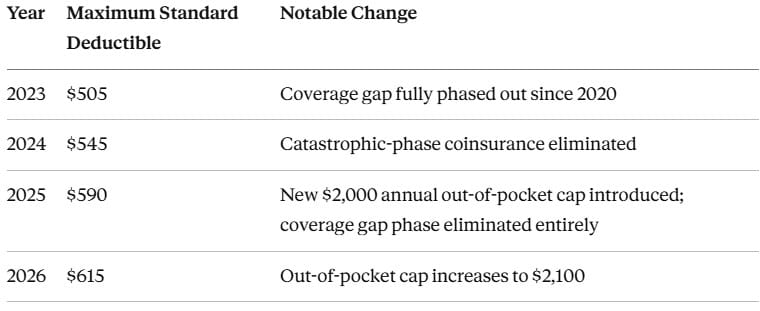
The confirmed 2027 deductible ($700) and out-of-pocket cap ($2,400), since CMS already finalized those in its April 2026 rule.
Figures reflect the maximum standard deductible allowed; individual plans may charge less, and some charge $0. These amounts are set annually and are provided here for general reference — always confirm current-year figures with your plan.
The bottom line: the "donut hole" that once caused so much financial anxiety no longer exists in its original form. Today's Part D structure is simpler and includes a real, hard ceiling on annual drug costs — a meaningful improvement for anyone managing multiple prescriptions.
Understanding Drug Tiers
Every Part D and MA-PD plan organizes its covered medications into a formulary, and within that formulary, drugs are grouped into tiers that determine your cost:
Tier 1 – Preferred Generic: Typically the lowest copay
Tier 2 – Generic: Slightly higher cost than Tier 1
Tier 3 – Preferred Brand: Brand-name drugs the plan prefers, moderate cost
Tier 4 – Non-Preferred Drug: Higher-cost brand or generic options outside the preferred list
Tier 5 – Specialty: The highest-cost tier, typically for complex or high-cost medications, often priced as coinsurance rather than a flat copay
The same medication can sit in different tiers on different plans, which is exactly why comparing your specific prescriptions against a plan's formulary — rather than assuming "all Part D plans are the same" — matters enormously.
How Your Choice of Pharmacy Affects What You Pay
Many beneficiaries are surprised to learn that where you fill a prescription can change the price as much as which drug you're filling. A few factors to know:
Preferred vs. standard network pharmacies. Most plans have a network of "preferred" pharmacies where copays are lower, alongside "standard" network pharmacies where the same drug may cost more, even though both accept your plan.
Out-of-network pharmacies may not be covered at all outside specific circumstances, meaning you could pay the full retail price.
Mail-order pharmacy programs often provide meaningful savings for beneficiaries on long-term, maintenance medications, frequently offering a 90-day supply for a lower total cost than three separate 30-day fills at a retail pharmacy.
Before settling on a plan, it's worth checking not just whether your medications are covered, but whether your preferred pharmacy — or a mail-order option — falls into that plan's preferred network.
Let's Make Sure Your Drug Coverage Actually Fits Your Medications
Part D decisions aren't one-size-fits-all, and the "best" plan for your neighbor may not be the best plan for you, depending on your specific medications, pharmacy preference, and budget.
As a licensed, independent Florida agent, Dean Vella will walk through your actual prescription list, compare it against real plan formularies, and help you avoid both the late enrollment penalty and an unnecessarily expensive plan — at no cost to you.
This guide is for educational purposes and does not constitute medical, legal, or tax advice. Proper Coverage Insurance is not connected with or endorsed by the U.S. government or the federal Medicare program. We are an independent, licensed insurance agency offering Medicare plan comparisons in Florida.
Content reviewed as of July 2026. Medicare rules, deadlines, and penalty calculations are set by CMS and Social Security and are subject to change — always confirm current requirements before making an enrollment decision.