
Medicare Enrollment Periods Explained: A Complete Timeline for Parts A, B, and D
The Question Every Floridian Approaching 65 Eventually Asks
When do I actually need to sign up for Medicare?"
It sounds like a simple question. In practice, the answer depends on whether you're collecting Social Security, whether you're still working, and how large your employer is. Get the timing wrong, and you risk a permanent penalty or a gap in coverage. Get it right, and Medicare becomes something you barely have to think about.
This guide walks through every major enrollment scenario for Parts A, B, and D — in plain language, with the timelines that actually matter.
Step One: Understanding Eligibility
Most people become eligible for Medicare the month they turn 65, as long as they (or a spouse) have enough work history paying Medicare taxes. That eligibility triggers your Initial Enrollment Period (IEP) — a 7-month window:
3 months before your birthday month
Your birthday month
3 months after your birthday month
What happens within that window — and whether you need to act at all — depends entirely on the scenarios below.
Is Part A Automatic? It Depends on Social Security
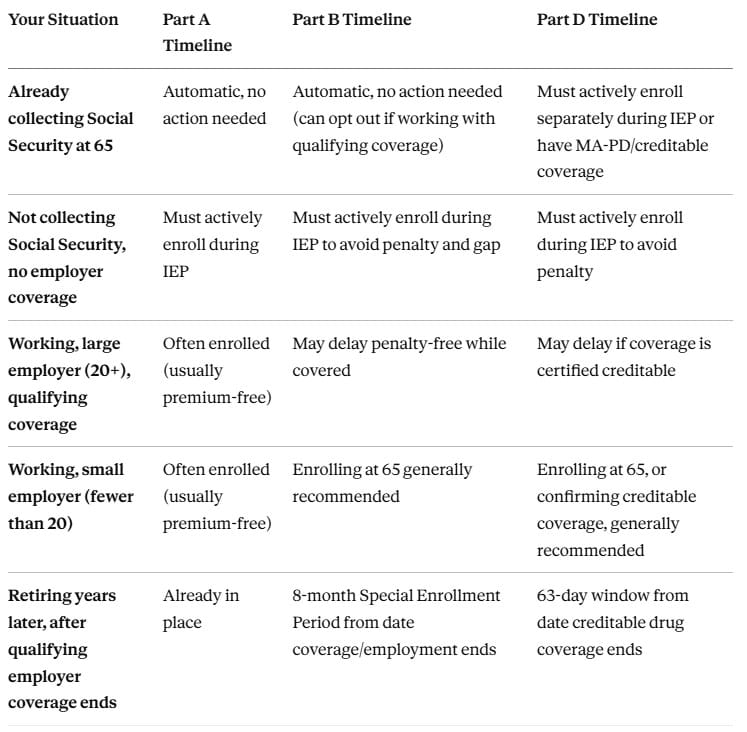
When Part A is automatic: If you are already collecting Social Security or Railroad Retirement Board benefits at least 4 months before turning 65, you'll be automatically enrolled in Part A (and Part B) without lifting a finger. Your Medicare card simply arrives in the mail, typically about 3 months before your 65th birthday.
When Part A is not automatic: If you have not yet filed for Social Security by that point — whether because you're still working or simply delaying your claim to grow your benefit — Medicare has no way of knowing you're turning 65. You must actively apply for Part A yourself, either online through Social Security or in person.
Most people still choose to enroll in Part A even without claiming Social Security, since it's typically premium-free for anyone with sufficient work history.
How Part B Enrollment Actually Works
Part B follows the same automatic-vs-not pattern as Part A, but with one added wrinkle: Part B carries a monthly premium, so many people who are still working with qualifying coverage choose to actively delay it — which requires a specific action, not just silence.
If you're automatically enrolled (because you're already collecting Social Security), you technically have the option to decline Part B if you have qualifying employer coverage. This means returning the instruction card that comes with your Medicare card to opt out of Part B specifically, while keeping premium-free Part A.
If you're not automatically enrolled and you have no employer coverage, you generally need to actively sign up for both Part A and Part B during your IEP to avoid a coverage gap and a future late enrollment penalty.
If you're not automatically enrolled and you do have qualifying employer coverage, you can generally enroll in Part A only and delay Part B — but whether that delay is penalty-free later depends entirely on your employer's size, covered in detail below.
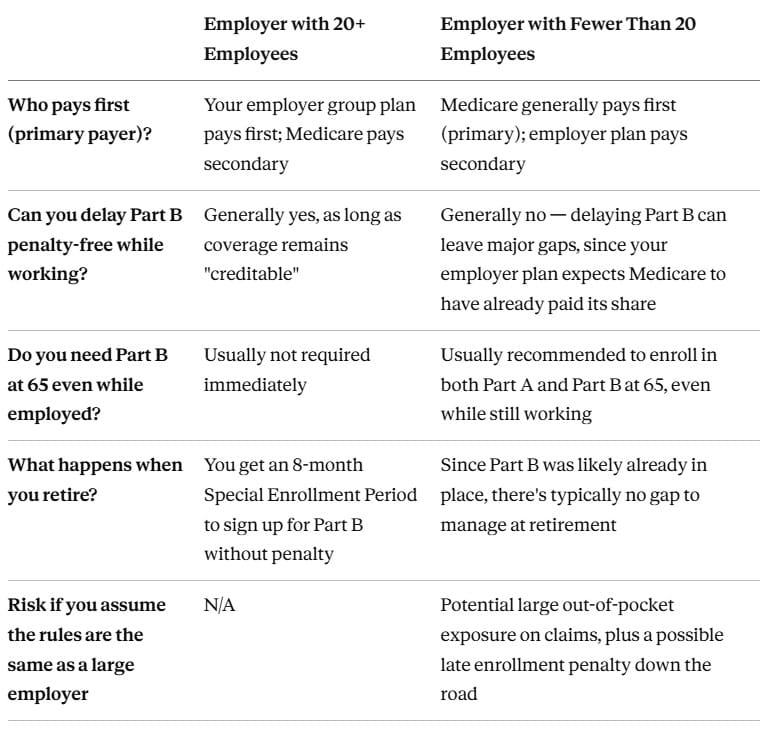
The Employer Size Question: Under 20 vs. 20 or More Employees
This single detail — how many people work at your company — fundamentally changes how Medicare and your employer coverage interact.
When Do You Have to Sign Up for Part B?
Pulling all of the above together, here's exactly when Part B enrollment becomes necessary:
No employer coverage at all: Enroll during your 7-month Initial Enrollment Period. Missing this window without a qualifying employer coverage exception can trigger a permanent late enrollment penalty of 10% for each 12-month period you delayed.
Working with a large employer (20+ employees) and qualifying coverage: You may delay Part B penalty-free for as long as that coverage continues.
Working with a small employer (fewer than 20 employees): Enrolling at 65 is generally the safer path, even while still employed, due to the primary payer shift described above.
Retiring after delaying Part B under qualifying large-employer coverage: You must enroll within an 8-month Special Enrollment Period that begins the month after your employment ends or your group coverage ends, whichever comes first. This window is not automatic — you must proactively notify Social Security and provide proof of prior creditable coverage.
Part D: A Separate Timeline of Its Own
Part D (prescription drug coverage) shares your Initial Enrollment Period, but has its own separate rules once you're past it:
Initial Enrollment Period: Same 7-month window as Parts A and B.
Creditable coverage standard: Unlike Part B's 20-employee threshold, Part D's rule is based on whether your employer or union drug coverage is certified as "creditable" — meaning it's expected to pay at least as much as standard Medicare drug coverage, regardless of company size. Employers must notify you annually whether your coverage qualifies.
Annual Enrollment Period (AEP): October 15 – December 7 every year, when anyone can join, switch, or drop a Part D or MA-PD plan for the following year — a window Part B does not have.
Special Enrollment Period after employer coverage ends: Similar to Part B, you generally have 63 days after creditable drug coverage ends to enroll in Part D before a late penalty begins accruing.
The penalty: 1% of the national base beneficiary premium for every month you went without creditable drug coverage, added permanently to your Part D premium.
Putting It All Together: A Scenario-Based Timeline
Don't Navigate This Alone — Get Your Timeline Confirmed
Every one of these scenarios has a different deadline, and missing the right one can mean a penalty that follows you for the rest of your life. As a licensed, independent Florida agent, Dean Vella will walk through your specific situation — your Social Security timing, your employer coverage, your company size — and map out exactly when you need to act, at no cost to you.
This article is for educational purposes only and does not constitute medical, legal, or tax advice. It is not connected with or endorsed by the U.S. government or the federal Medicare program. Enrollment rules, penalties, and thresholds are subject to change and can vary by individual circumstance. Speak with a licensed agent or the Social Security Administration to confirm the rules that apply to your specific situation.
Content reviewed as of July 2026. Medicare rules, deadlines, and penalty calculations are set by CMS and Social Security and are subject to change — always confirm current requirements before making an enrollment decision.