
Medicare Supplement Insurance: History, How It Works, and Comparing Plans A Through N
The Coverage Gap Medicare Never Fully Closed
Original Medicare was never designed to cover 100% of your healthcare costs. Deductibles, 20% coinsurance with no cap, hospital cost-sharing after extended stays — these gaps have existed since the program began, and they're exactly why Medicare Supplement insurance, also called Medigap, exists today.
If you've seen Medigap plans listed by letter — Plan A, Plan G, Plan N — and wondered why there are so many, and why some seem to disappear depending on when you turned 65, this guide walks through the full picture: where these plans came from, what they actually do, how the lettered plans differ, which ones are most popular today, and the honest trade-offs of choosing this path.
Where Medigap Came From: A Brief History
1965 — Medicare is created, and gaps exist from day one. From its earliest days, Original Medicare left beneficiaries responsible for deductibles and coinsurance. Private insurers began selling supplemental policies almost immediately to fill those gaps.
1980s — An unregulated, confusing marketplace. For nearly two decades, Medigap policies were sold with no standardization at all. Different insurers offered wildly different benefit combinations under similar-sounding names, and reports of aggressive sales tactics and seniors purchasing duplicate, overlapping policies became a serious national concern.
1990 — Congress steps in with standardization. The Omnibus Budget Reconciliation Act of 1990 (OBRA '90) required Medigap policies to be standardized into a defined set of lettered plans, so that a "Plan C" from one insurer covered exactly the same core benefits as a "Plan C" from any other. This took effect in 1992, originally creating ten standardized plans, labeled A through J.
2010 — The lineup gets revised. Federal rules updated the standardized plans, eliminating Plans E, H, I, and J for new enrollees, while introducing Plans M and N to offer different cost-sharing structures. Some older benefits, like at-home recovery coverage, were phased out as part of this update.
2020 — First-dollar coverage plans close to new enrollees. The Medicare Access and CHIP Reauthorization Act (MACRA) of 2015 phased out Plans C and F for anyone newly eligible for Medicare on or after January 1, 2020.
The reasoning: policymakers wanted to reduce "first-dollar coverage" plans that paid the Part B deductible entirely, since some research suggested that fully first-dollar coverage could encourage beneficiaries to use more services than necessary. Anyone who was already eligible for Medicare before that date can still buy or keep Plans C and F today.
That history explains today's landscape: ten standardized plans still exist (A, B, C, D, F, G, K, L, M, and N), but C and F are only available to a shrinking pool of beneficiaries who qualified before the 2020 cutoff.
What Medigap Actually Does
Predictable costs. Instead of an uncapped 20% coinsurance exposure under Original Medicare alone, a Medigap plan converts that risk into a steady, known monthly premium.
No network restrictions. You can see any doctor or hospital nationwide that accepts Medicare, with no referrals required.
Guaranteed renewability. As long as you pay your premium, your insurer cannot cancel your Medigap policy due to declining health.
Simplicity for travelers and multi-state residents. Since there are no networks, coverage works the same whether you're in Florida or visiting family across the country.
Comparing Medigap Plans A Through N
Here's how the ten standardized supplement plans differ in core coverage:
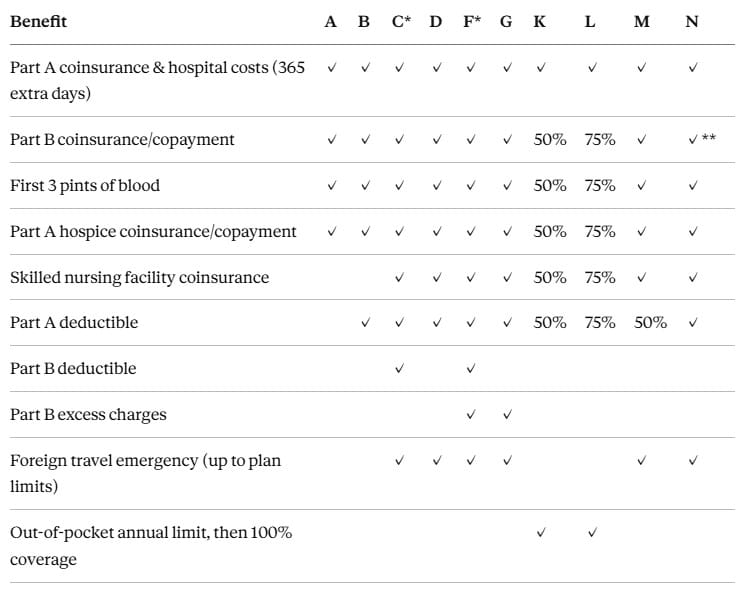
Plans C and F are only available to beneficiaries who were eligible for Medicare before January 1, 2020. *Plan N pays Part B coinsurance in full, except for small copayments (typically up to $20 for some office visits and up to $50 for ER visits that don't result in admission).
A few key medigap differences worth understanding:
Plan G is the most comprehensive plan available to anyone newly eligible today — it covers everything on this chart except the annual Part B deductible.
Plan N trades a lower premium for small, predictable copays on office and ER visits, along with no coverage for Part B excess charges.
Plans K and L work differently than the rest: instead of covering a fixed percentage of every cost, they cover a portion of most benefits, but include an annual out-of-pocket limit — once you hit it, the plan pays 100% of covered costs for the remainder of the year.
High-deductible versions of Plans F and G are also available in most states, offering the same coverage at a lower premium in exchange for paying a set deductible amount out of pocket before the plan begins paying anything.
Plans A and B offer the most basic coverage, with fewer benefits than the mid-tier and comprehensive options.
Note: Massachusetts, Wisconsin, and Minnesota structure their Medigap plans differently than the standardized lettered system used in the rest of the country.
Which Plans Are Actually Most Popular?
Popularity among Medigap plans has shifted dramatically over the years, largely driven by the 2020 rule change:
Plan G is currently the most popular Medigap plan nationwide by a wide margin, chosen by roughly one in three Medigap enrollees, since it's the most comprehensive option available to anyone newly eligible.
Plan F, while closed to new enrollees since 2020, still has a substantial base of beneficiaries who were grandfathered in before the cutoff and have simply kept their coverage.
Plan N has grown steadily as a popular alternative for beneficiaries comfortable with small office and ER copays in exchange for a lower monthly premium.
Plans A, B, K, L, and M make up a much smaller share of the market, generally chosen by beneficiaries prioritizing the lowest possible premium over broader coverage.
Pros and Cons of Choosing Medigap
Pros:
Predictable, capped monthly costs instead of uncapped coinsurance exposure
No provider networks or referral requirements, valid nationwide
Coverage stays consistent year to year, with no annual plan redesign to track
Especially valuable for beneficiaries with chronic conditions, frequent specialists, or multi-state living
Cons:
Higher monthly premiums than most Medicare Advantage plans
No prescription drug coverage — a separate Part D plan is required
No extra benefits like dental, vision, or hearing built in
Applying outside your Medigap Open Enrollment Period may involve medical underwriting, and in many states, health conditions can affect your ability to enroll or your premium
Let's Find the Right Plan for Your Situation
With ten standardized plans, shifting eligibility rules, and premiums that vary by carrier, comparing Medigap options on your own can be overwhelming. As a licensed, independent Florida agent, Dean Vella will walk through your health needs, your budget, and the specific plans available where you live, and help you compare real options side by side — at no cost to you.
This article is for educational purposes only and does not constitute medical, legal, or tax advice. It is not connected with or endorsed by the U.S. government or the federal Medicare program. Plan availability, benefits, and premiums vary by state and carrier and are subject to change. Speak with a licensed agent to review the specific plans available in your area.
Content reviewed as of July 2026. Medigap plan structures, eligibility rules, and cost-sharing amounts are set by CMS and are subject to change — always confirm current requirements before making a plan decision.